
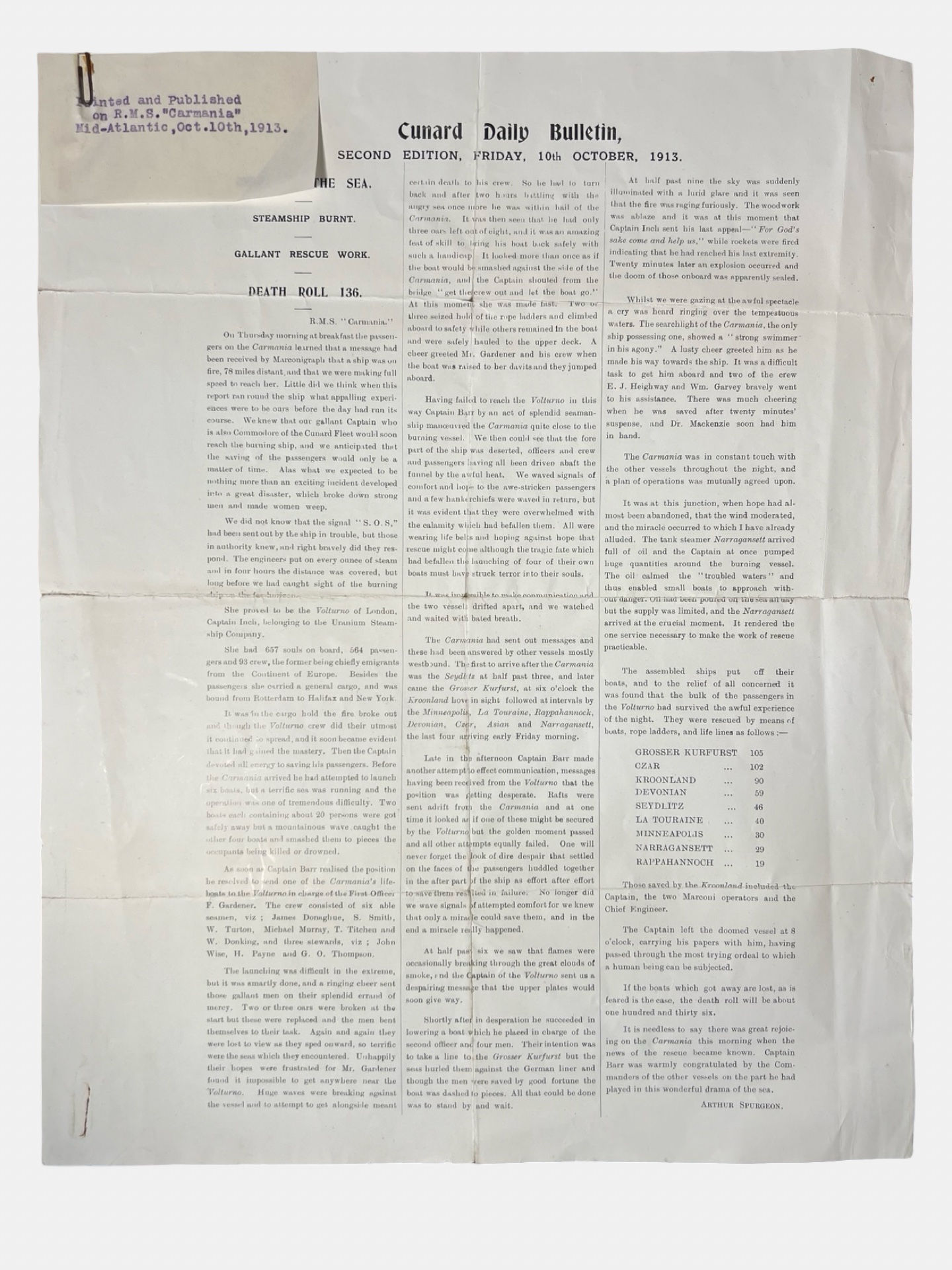

Cunard Daily Bulletin about the burning of the Volturno Sir Arthur Spurgeon 1913
A CONTEMPORARY ACCOUNT OF THE RESCUE OF THE VOLTURNO
SPURGEON, Sir Arthur. Cunard Daily Bulletin. Second Edition. Friday 10 October 1913.
Printed broadside, 280 x 360 mm. Printed aboard RMS Carmania during her mid-Atlantic crossing on 10 October 1913. Old fold lines from contemporary folding, tape reinforcement to sections of the reverse margin, light creasing and handling marks, otherwise good. Contemporary docket note attached with a paper clip top left.
Exceptionally scarce contemporary account of the rescue of the burning steamship Volturno, written by Sir Arthur Spurgeon and printed aboard RMS Carmania on the very day of the disaster. Drawing upon events witnessed from the rescue fleet, Spurgeon provides a detailed narrative of Captain James Barr's repeated attempts to reach the stricken vessel in heavy seas, the extraordinary courage of the Carmania's crew, the arrival of vessels answering the Marconi distress calls, and the eventual rescue of survivors. The bulletin records a provisional death roll of 136 and includes a breakdown of the numbers rescued by each participating ship.
The Cunard Daily Bulletin was printed aboard Cunard liners for passengers during transatlantic voyages, carrying news received by Marconi wireless together with reports of events affecting the voyage. Produced while the rescue operation was still unfolding, this Second Edition represents one of the earliest published accounts of the Volturno disaster.
Arthur Spurgeon (1862-1933), publisher, journalist and managing director of Cassell & Co., was travelling aboard Carmania during the rescue. His eyewitness dispatches, transmitted by Marconi wireless from the scene, became the first widely circulated reports of a major maritime disaster sent directly from the rescue fleet and were later expanded into his book The Burning of the Volturno (1913). This bulletin therefore represents the original published appearance of Spurgeon's account, printed and distributed aboard the ship from which it was written.